Backpacking our way across the enigmatic Balkans

The word "enigmatic" comes to mind when trying to describe the Balkans. It’s a part of Europe that is undeniably beautiful, but still brimming with raw emotion after years under communist rule and subsequent bloody wars.
Backpacking through these countries, particularly Bosnia and Herzegovina, was an absolute standout experience from this year abroad. However, it was difficult to reconcile the fact that countries home to such beauty are also places of unfathomable human pain. Paddy and I spent three weeks bus-hopping our way from Croatia to Albania, and I am already counting down the days until I can go back to do it all again.

Bihać (pronounced bee-hach)
We started our Balkans journey with a brief stop in Zagreb (Croatia's capital) before heading to Bosnia and Herzegovina. We jumped on a minibus from Zagreb's main bus terminal and spent three hours making our way to Bihać, a small town situated on the Una River in northwest Bosnia. Like most rivers in the Balkans, this one was a vivid blue and flowing with crystal-clear water.

During our three-night stay, we enjoyed munching on some fish and chips, plenty of warmer weather, kayaking and strolls around the river.
We stumbled across a vibrant autumn harvest and cooking festival on our first full day in the town. A local band performed fun folk songs, locals danced, chefs cooked regional specialties, and everyone seemed very merry.
Bihać was the least touristy part of Bosnia we visited. The town isn’t far from the Una National Park, which is filled with waterfalls and little villages. However, these are easier to reach with a car, so we opted to stay around Bihać and spent a day kayaking to the north of the town instead.

The best day in Bihać was spent on a kayaking tour along the River Una. We spent a couple of hours gliding down the river, navigating some rapids, and talking to our guides about Bosnia. They told us about the war in the 1990s, in which their fathers and grandfathers had fought. You could still see the damage in many parts of the town, with several buildings covered in bullet holes.

Our guides said some people choose to leave their damaged walls on display as a reminder of the region’s dark past. They said the locals didn’t have access to proper weapons during the war and often went to battle with farming guns and wearing their old Converse shoes. We continued to learn about this devastating history throughout our time in Bosnia and Herzegovina.
Bihać was a delightful introduction to Bosnia and the Balkans. The nature was so pristine and vibrant compared to what we saw in Eastern Europe. The only downside was the town's fairly limited food options. We did enjoy some sublime local trout and chips. Outside of that, we were restricted to fairly meat-heavy meals, baked goods and a single Italian restaurant. Luckily, the further we travelled through the Balkans, the more our food options expanded!
Jajce (pronounced yah-tzeh)

The next stop on our Balkans tour was another town filled with beautiful autumnal colours and a stunning river. Jajce is a popular day trip from Sarajevo because it sits on the Pliva River, which plunges into a powerful waterfall at the town’s edge. It’s also home to a lot of history.
Jajce was the ancient capital of the Bosnian kings until the Turks invaded in the late 1400s. It also played an important role in the country’s modern history. It was here that the Yugoslav constitution was drafted and the Federal Republic of Yugoslavia was founded after World War II.

I spent a bit of time in bed here because I’d once again come down with a cold. So, I took a couple of days to sleep it off. Between my naps, I got out to explore the quiet and oddly empty town.

We later discovered that many cities and rural villages remained littered with empty buildings after the Bosnian War (1992-1995). An estimated 100,000 people were killed during the war, and millions were displaced. We learnt that many have never returned, thus the high number of derelict and empty buildings around the country.
The town centre was home to an old castle from when the country was a kingdom, as well as a mosque and a church. Despite the devastation of the Bosnian War and other atrocities in the 1990s, many different religious groups continue to call the Balkans home. You will find mosques and orthodox churches peacefully coexisting right across the Balkans.
Pliva watermills
One of Jajce’s biggest drawcards is the picturesque rapids and Pliva watermills just outside of the town. Once I had regained some more strength, I ventured out with Paddy to explore the magical sights on offer. We strolled along the river for about an hour or two, stopping at a few impressive cascades along the way.

The watermills, known as Mlinčići, are truly beautiful. They sit over cascading water, mossy hills, and under lush trees. The mills were used to grind grain into flour for around 400 years. Although they are no longer in use, they serve as a quirky reminder of how locals once lived. Ricketty boardwalks still link the 19 huts together, which allows you to explore them freely. We even spotted old grinding mechanisms underneath some of the mills!
Having enjoyed a good dose of nature and delved into some history, we were ready for another city. Our sights were now set on the capital, Sarajevo. We took another early morning minibus and arrived in the quaint city about three hours later.
Sarajevo (pronounced sah-ra-yeh-vo)
I loved Bosnia's capital. It was freezing and smoggy, which wasn't ideal as I had yet to recover from my cold, but I seriously loved it. The old town was full of life and had a distinctly different feel from everywhere else we had travelled in Europe. They say it is where the "East meets the West". One part of the city feels starkly Austro-Hungarian, the other (my favourite part) had a distinct Ottoman energy.
We noticed lots of differences here. The first being the coffee! It was served in beautiful copper pots and smelled a lot like traditional Turkish coffee. Being a Muslim majority city, there weren't many alcohol-related evening activities. Instead, coffee and cafe culture thrived. The old town centre was constantly buzzing, with tourists during the day and keen cafe goers in the evening.
There were quite a few touristy shops, some selling souvenirs made from bullets or other wartime paraphernalia. I also noticed plenty of Palestinian flags and some shops selling paintings that illustrated the plight of the Palestinians.
Paddy and I spent most of our time in Sarajevo eating good Bosnian stews, trying some sweets, learning about the city's horrific past, and soaking up the historic sights. Most people know of Sarajevo as the place where Archduke Franz Ferdinand was assassinated before the start of World War I. The city also hosted the Winter Olympics during the 1980s when it was part of the former Yugoslavia.
More recently, it became the centre of a four-year siege. Serb forces laid siege to Sarajevo between 1992-1995, killing more than 11,000 civilians through sniper fire and shelling. Again, this heartbreaking history is still visible today. Many buildings are covered in bullet holes, and damaged sections of the ground have been coloured with red paint to signify where innocent civilians died.

We were also able to escape the city and make our way up into the Dinaric Mountains for a day-hike to Lukomir. This was a wonderful way to experience some traditional Bosnian practices, such as shepherding and knitting, that have been kept alive. I wrote about this stunning hike and my other favourite outdoor adventures in Europe here.
Mostar
The landscape on the drive between Sarajevo and Mostar was insanely beautiful and diverse, featuring everything from orange-toned vineyards to crystal-clear turquoise rivers, arid stony mountains and dams. It was a lovely mix, and Mostar itself is every bit as charming as the photos show! It was misty and lightly sprinkling when we arrived in the historic town.

We spent three nights in Mostar, staying in one of the most wholesome, homely hostels I’ve ever experienced!! Majda’s was about 10 minutes from the town centre and was run by a gorgeous local family. Majda greeted us with tea and burek while briefly explaining the local area and history. She became our adoptive mother during those three days, even bringing out bowls of popcorn when we sat in the common area with other backpackers in the evening.
We spent our days exploring the old town, including the famous Old Mostar Bridge! This area is really popular with Aussie travellers, and most locals say that’s thanks to Hamish and Andy, who filmed themselves jumping from the old bridge for a TV show about a decade or so ago. The bridge is roughly 22 metres high (depending on the tide), and people now pay €50 to take the madman dive into the river below. It was pretty cold when we were there, so we didn’t see anyone jump.

My favourite part of Mostar was the wine! Bosnia and Herzegovina is known for its delicious wine. We went to a couple of wine shops for some tastings and were delightfully surprised by how tasty they all were! Paddy reckons one of the local red varieties was the best wine he’d ever had. The area has a rich history of winemaking, dating back potentially thousands of years!
After quite a few wines, spirits and local cheeses, we were tempted enough to buy a bottle of red and some local spirits for the road. We opted for the Trnjak wine, which is only found in this part of the world! The wine is made from a male variety of grapes, and commercial production only began in the past decade.
We learnt a lot more about Bosnia’s devastating history in Mostar. I spent some time exploring the town’s genocide museum. It detailed the impact of the Bosnian war on Mostar locals, as well as the horrific Srebrenica massacre, where 8,000 Muslim men and boys were murdered. It was a heartbreaking museum, but I think an incredibly powerful and important place to visit.

The museum ended with a vibrant display of Post-it notes from the thousands of visitors. The majority spoke about world peace, and many had the words “Free Palestine” written down.
We learnt the most about the region’s more recent history through Majda’s brother. Bahta often takes backpackers on a long day trip around the historic sites of Mostar, as well as important and interesting places outside of the town.
Majda and Bahta's family was separated during the Bosnian War. After they were able to move back home, the family decided to open a hostel and share their stories with travellers.
Kravice Waterfalls, Počitelj and Blagaj
Paddy and I are so glad we chose to explore the broader Mostar region with Bahta. He took us to a lot of places! We started the day with a ridiculously delicious and hearty breakfast, courtesy of Majda, who wakes up at an ungodly hour to cook her guests a feast every morning. Bahta then took a group of us, whom he affectionately called "bloody backpackers", in his beat-up car around Mostar.

Bahta was very keen to show us all facets of life in his region. So, we first visited the beautiful Kravice Waterfalls, probably Bosnia’s most famous destination. Given it was autumn, we had the place mostly to ourselves! Paddy was brave enough to delve into the icy depths, but I was happy to admire it from the shore.

From here, we wound our way up to a spectacular abandoned village called Počitelj. It was once a feudal seat but fell to the Ottomans in the 1470s. The city sits above the Nerevta River and is home to an impressive fortress.
We were able to roam the entire city for free and got to see wonderful views of the surrounding mountains. I even climbed along a dodgy fortress wall and up into the old tower despite my serious fear of heights.
Bahta told us that the Bosnian War saw most of the Muslim population displaced from the town, and few ever returned. As such, it is now practically a ghost town. A few people still tend to the pomegranates and olives, with some ladies also selling juice to the odd visitor.
It was one of the most impressive historic cities I’ve explored on this trip, and I'm surprised it’s not a more popular tourist destination.
The final stop for the day was Blagaj. This is home to a historic Sufi monastery built in the 1600s. The Sufi religion is most known for its whirling dervishes from Türkiye. This religious order has become synonymous with the fast-paced spinning rituals that help them connect with God. The monastery is situated along a river that emerges from a cave. It was very picturesque and peaceful. Bahta said the caves above were also home to some historic relics that showed the native Bosnian people’s pagan rituals from before the time of Ottoman rule.

Bahta used our time here to load us up with much more information from the Bosnian War and current issues the community is facing. He said many people remain segregated today, and believes that Bosniaks still hold less power than the Croats in Mostar. It was a lot of information to digest, and by the end of the day, my brain felt exhausted. However, I’m grateful to have spent the day with Bahta, learning about this history and its ongoing impacts.

Bosnia and Herzegovina was truly one of the highlights of our year abroad. It had some of the most stunning scenery, the bluest rivers, the most resilient people, and a wonderful mix of Turkish/Balkan culture.
Kotor, Montenegro
Montenegro drew the short straw on our Balkans trip. Originally, I had wanted to spend a week or so travelling around the country. However, we decided to compromise so we could spend more time in Albania and Türkiye instead. So, that meant we merely used the country as a transition point to get from Bosnia to Albania. But, it was a very picturesque transition point!
The bus ride from Mostar to Kotor was among the most scenic we’ve taken on this trip. As you cross the border, it doesn’t take long for the ocean and an expansive bay to come into view. We spent nearly two hours winding around the peculiarly shaped bay to reach Kotor. We passed waterfalls flowing from the mountains into the ocean, idyllic swimming spots, and never-ending towering vistas.

We spent two nights in Kotor and truly tried to make the most of our séjour. We stayed in a hostel in the old town, giving us easy access to the harbour and all of Kotor’s historic sights. The town is known for its cats, and A LOT were wandering around the old streets. I counted dozens, if not hundreds!
It was a lot more expensive here than in neighbouring Bosnia. As such, we didn’t indulge in too many meals out; instead, we treated ourselves to a night of cheese and wine on the hostel rooftop. We’d picked up some delicious olives from a local market along the harbour front and had them accompany our Bosnian wine.
The best thing we did in the town was climbing the Ladder of Kotor, a trail that is very popular with backpackers and families. The trail climbs up the steep mountains sitting behind Kotor and is made up of dozens of switchbacks.

There’s even a little impromptu cheese and wine shop that you can stop in at along the way! We enjoyed some yummy pomegranate juice in the “shop” while waiting for the rain to subside.
Once at the top, you reach a sneaky back entrance to St John’s Fortress. This route is becoming increasingly popular with backpackers because you avoid paying the €15 fee to enter the fortress! Usually, there is a ladder in place to help you climb through a hole at the back. However, there was just a tree branch when we visited, which meant we had to do some mad scrambling to get into the fortress. Once inside, we could see the entire bay, the old town and 360-degree mountain views.
Kotor was a beautiful pit stop. I wish we’d had more time to explore the rest of Montenegro, but I am glad we spent the little time we had in the country in Kotor. I’ll be back!
Shköder, Albania

Our stay in Shköder was brief but lovely. It’s essentially the first major town you come across when travelling from Montenegro to Albania. The purpose of our visit was to use the town as a launching pad into the majestic Albanian Alps. The city itself is very peaceful, filled with quaint cobblestone streets, cafes and bars.
We stayed at the Wanderers Hostel, where we met some delightful humans, and then headed up into the mountains for some hiking bliss. We spent about three days in the alps (hiking from Valbonë to Theth), which I’ve written all about here.
Some of my favourite sights in the mountains were the autumn leaves and nuclear bunkers still dotted around the countryside.
More than 170,000 bunkers were built during the country’s communist rule. Albania was one of the world’s most isolated countries between the 1950s and 1990s. Enver Hoxha was the country’s first communist leader.
He became increasingly paranoid during his time in power, even accusing countries such as China and Russia of not being communist enough. The Albanian military even took inspiration from North Korea, which led to the creation of some complex and insane bunkers across the country.
Tiranë (pronounced tir-ah-na)
After exploring the mystical high country, Paddy and I travelled to the capital. Tiranë is a small but lively city. The traffic is utterly chaotic, probably because most people didn’t have cars until the late 1990s. However, it has a rich history and lively feel! I particularly loved the markets, street vendors, and dramatic buildings.
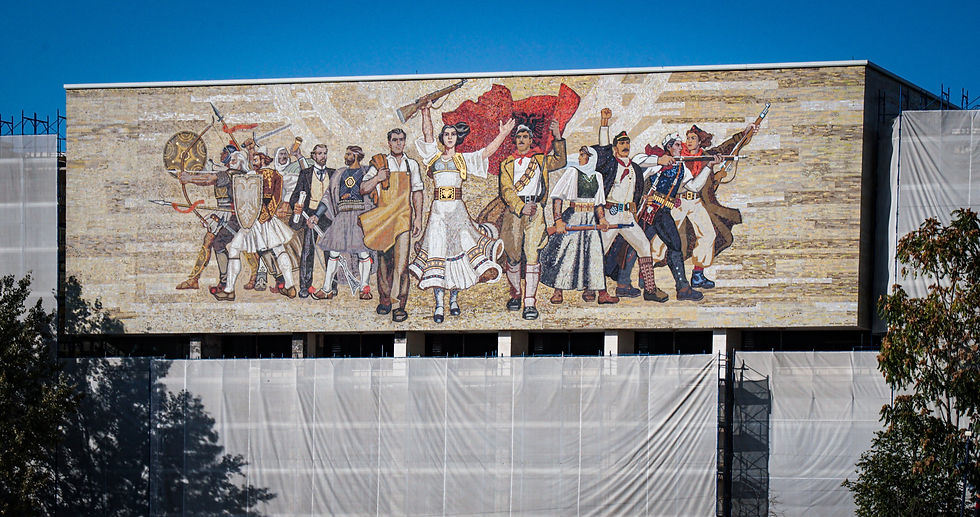
We enjoyed a great walking tour through the city one day, and noticed the skyline filled with odd towers. Our guide told us that the capital wanted to become known for more than the country's dark past, so it was investing in lots of quirky architecture. One building was shaped as the head of the country’s national hero, Skandaberg, and another had balconies protruding in the shape of Albania. The city is also home to a dazzling mosque, filled with intricate motifs on the inside. It was one of the only religious buildings to be spared during the communist regime.

Tourism is bloody booming in Albania. We were told that Tiranë only saw about five million tourists in 2019. Within the last year alone, they’ve seen nearly 12 million!! And strangely enough, there are a lot of Aussies coming here. Pretty much every single traveller we met in Albania was an Australian. I still haven’t figured out if there’s a specific reason for that, but I suspect it’s down to the lower prices and sublime nature.
There was also a decent nightlife scene and great food options in Tiranë! We had some amazing seafood and some of the freshest meals of the Balkans here. The best place we visited was BUNK'ART1, a former communist bunker transformed into a museum. It was about six floors deep, quite creepy, and very informative! The museum is located on the city’s outskirts, but it was easy to reach by public bus. They’ve even made a smaller version in the city centre for those short on time.
After a solid, jam-packed three weeks in the Balkans, it was time to say farewell. We ended the trip with a fun night out with some other travellers before packing our bags and jumping on a long-haul bus to Greece. We were on our way to Istanbul, with a two-night stop in Thessaloniki, where we ate some incredible seafood and gyros. Then we were back on the bus, bound for a month-long Turkish adventure.


Comments